
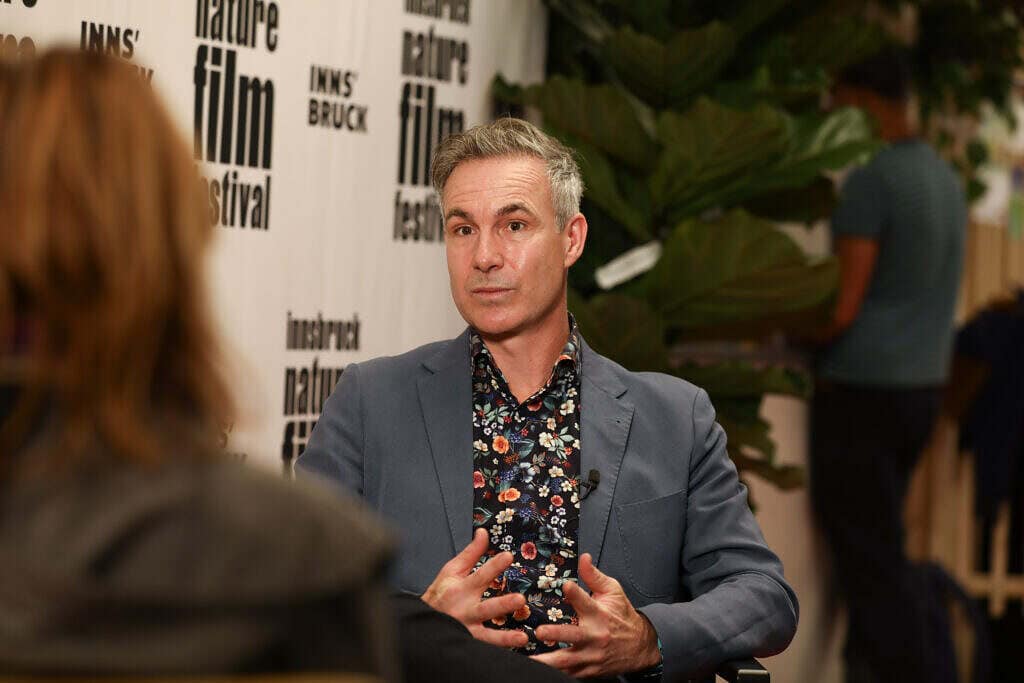
© Mickael Chavet
inff: Niobe Thompson, you’re back to Innsbruck for the Jury and the innsbruck nature film festival. Why do you think it’s very important to have festivals like this?
Niobe Thompson: Festivals are a gateway for audiences to films that are sometimes impossible to access any other way. So a festival will bring films from all over the world that are not necessarily playing on television or not available on the internet. And if you’re lucky enough to live in Innsbruck, you get access to this whole world. It’s a really rich, broad selection of films carefully chosen by the programmers and it’s just a wonderful privilege to be able to go to a film festival like this.
You asked why it’s important to have a festival like this for filmmakers like me. Festivals like the one here, are extremely important for getting your films out to the audiences. The support you get from festivals like inff helps you reach a bigger audience. We had a film here last year which won an award and an award like that really opens doors. So it’s as useful to the audience as it is to the filmmakers, I would say.
inff: What can nature filmmakers contribute to make a better world or to protect nature or the environment?
Niobe Thompson: I mean, most people now live in an urban environment and work in offices. If you’re lucky enough to live in Innsbruck, nature is close, but it’s not like that for most people. And so natural history filmmakers bring the natural world into your living room, right? And they remind us that there are millions of other worlds out there, natural worlds. They show us that animals are not just like wallpaper, they have their own intelligence and their own ways of being. They live in parallel worlds that have nothing to do with the human world. But they also show us the impact that our way of life has on the natural world and also what we can do to help animals to increase biodiversity, to bring endangered species back from the brink. In so many ways I think natural history is really a wonderful thing for people to watch.
The last thing I would say is that you know humans can heal in nature. They can find themselves in nature by going back into natural worlds we can take a moment, take a breath, touch grass, as they say, and open a new chapter in our own lives. I think seeing a film and a festival about the natural world is like a little taster of that opportunity.
inff: Did you have the opportunity to see the nature around Innsbruck? What do you think about it?
Niobe Thompson: I came for the first time last year with my teenage daughter who was studying in Italy. We mountain biked, gravel biked and hiked every day. We were here during the day and I loved it so much that this year I’m here with my wife and we’re spending even more time. I mean the environment here is absolutely incredible. I’m from Canada, we also have mountains, but we don’t have the infrastructure right so it’s much more difficult to get up into the mountains. Here in Innsbruck nature is so accessible and there’s so many different things you can do in it, so I absolutely love coming to Innsbruck. For me it’s half festival half nature.
inff: But do you think the nature, the mountains are accessible, but is the nature protected enough? Sometimes there are discussions here that it’s over tourism. And so how do you see this conflict between nature and tourism?
Niobe Thompson: Sometimes there are discussions here that it’s over tourism. And so how do you see this conflict between nature and tourism? Well, there’s always tension between development and biodiversity. But what I see here from a Canadian perspective is that there have been humans living on this landscape for millennia, since before the Bronze Age and before, and extracting a livelihood from this landscape and yet today it seems to me still to be a natural world and a human world in harmony. And what I see is that landowners and land users here respect nature and they work with it. There seems to be, from my perspective, incredible respect for the integrity of the natural landscape. And okay, there are roads and other forms of infrastructure, but humans have been living here since the Bronze Age. So considering that, this is far from a ruined landscape. I think it’s a natural heaven.
inff: Last question: on which project are you working on now? Are you working on a new film? What do you want to do?
Niobe Thompson: We have a number of projects in development. One of them is interesting for anyone who loves natural history. It’s about a population of chimpanzees on an island in Lake Victoria in Tanzania. The film is called Island of the Orphan Apes. This was the first reintroduction project for primates, for apes in history. And it was the famous German naturalist, Bernard Jimmich, who in 1966 brought zoo animals back to Africa. And we thought that the chimpanzees and the colobus monkeys and the rhinoceroses and the giraffes and the elephants, we thought they were gone. We thought they’d been killed and poached and hunted. But in fact, the chimpanzees have survived. And they’re extremely hard to see. They’re almost impossible to film. So we’ll have a film crew on this island for at least four months next year. And it can teach us some interesting things. How did these orphan chimpanzees with no skills of survival in the wild learn to live in the wild again and develop culture?
inff: Very interesting. I hope to see this film at the next festival.
Niobe Thompson: Yeah, we’d love to bring that film back to Innsbruck in the future.
inff: Thank you very much.
Niobe Thompson: You’re welcome.